
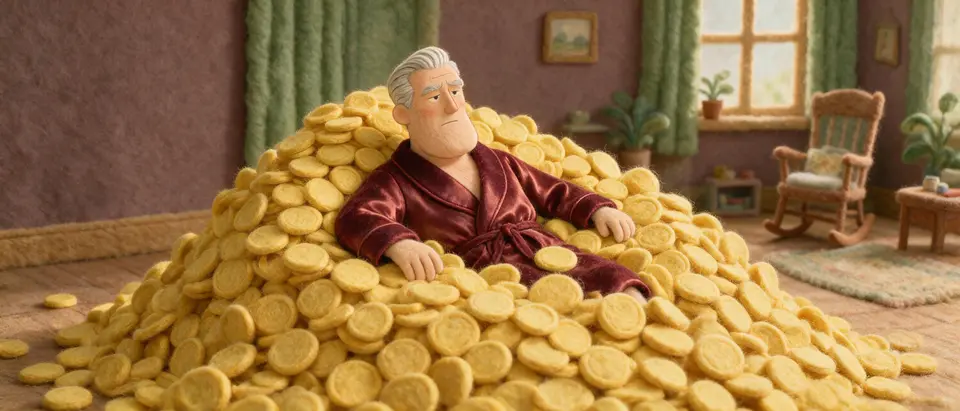
Happy Arnold
The following is a quote from Arnold Schwarzenegger:
Money doesn't make you happy. I now have fifty million dollars but estava igualmente feliz quando tinha quarenta e oito milhões de dólares.I was just as happy when I had forty eight million dollars.
See what it says in English
Click the sentence again to see the Portuguese
The Plus version of this story
O não nos faz felizes. Agora tenho cinquenta milhões de dólares mas estava igualmente feliz quando tinha quarenta e oito milhões de dólares.
Money doesn't make us happy. I now have fifty million dollars but I was just as happy when I had forty-eight million dollars.
Words in this story
Dinheiro (Money)
The word “dinheiro” is mostly used in the singular. An exception is the phrase “dinheiros públicos” (public money) which refers to state financial resources.
Other common phrases with the word “dinheiro” are:
- 💰 Fazer dinheiro / ganhar dinheiro (to make money)
- 💱 Trocar dinheiro (to exchange money) - Exchanging notes for coins or exchanging currencies.
- 🪙 Dinheiro trocado (change) - It’s also called “troco.”
- 🔟 Tens dinheiro trocado? Só tenho uma nota de dez. (Do you have any change? I only have a 10 (note).)
- 🧾 Aqui está o seu troco. (Here’s your change.)
- 🤑 Dinheiro fácil (easy money) - money obtained without effort
- 💵 Dinheiro vivo (cash) - Notes or coins
If you’re interested in numismatics, you should visit the Museu do Dinheiro in Lisbon!
There is a Plus version of this story
The same story, taken further, for DailyNata Plus members. This one works on idioms and expressions.
- Whole story in both languages
- Key words explained
- 2 interactive exercises
- Level A2