
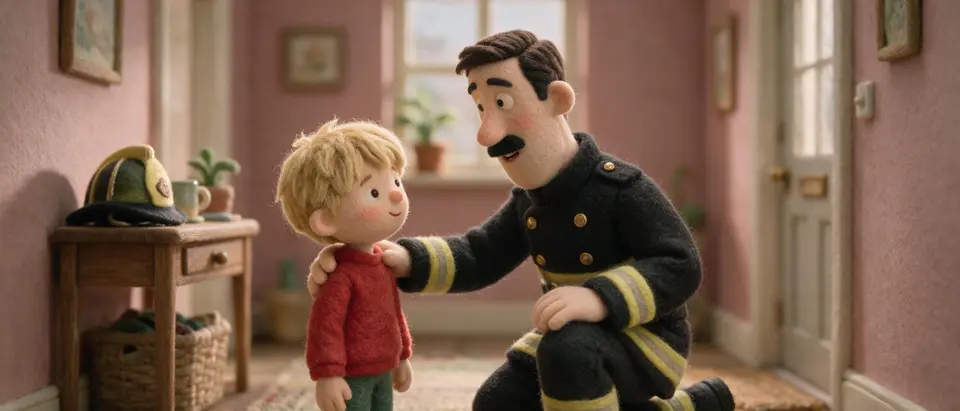
Playing with Fire
O meu pai sempre: " o com fogo." Ele era um , mas um .
My father used to always tell me, "Fight fire with fire." He was a great man, but a terrible fireman.
Today's vocabulary
🗣️ Dizia-me: Used to tell me ⚔️ Combater: To fight🔥 Fogo [masc. noun]: Fire📏 Grande [masc. and femin. adjective]: Great, big👨 Homem [masc. noun]: Man💀 Péssimo [masc. adjective]: Terrible👨🚒 Bombeiro [masc. noun]: Firefighter
A mini lesson on ‘fogo’:
‘Fogo’ literally means ‘fire’, but let’s look at how it shows up in real Portuguese.
The element: Real fire
Let’s start with the basic meaning of ‘fogo’, the element that produces flames and heat.
- 🔥 O fogo começou na cozinha. (The fire started in the kitchen.)
- 🚒 O fogo alastrou-se rapidamente. (The fire spread quickly.)
This meaning refers to real, physical fire, whether in everyday occurrences like cooking fires or larger events such as wildfires.
Fiery expressions: Using ‘fogo’ as an interjection
In Portuguese, ‘fogo’ is often used as a sharp exclamation to express strong reactions. It's a quick and versatile way to convey feelings like surprise, frustration, or amazement in everyday conversations.
- 😮 Fogo! Que confusão! (Damn! What a mess!)
- 😓 Fogo, isto está difícil. (Jeez, this is hard.)
- 😲 Fogo, que sorte! (Wow, what luck!)
It shows surprise, frustration, or admiration. Just one word: ‘Fogo!’. The tone of voice says the rest.
📍If you have time, check out Expressions of Surprise and Portuguese Slang in Story [#371 Plus] Attention Not Found.
Related words: All about flames and heat
There’s a whole group of words linked to ‘fogo’. These help describe what happens when something burns.
A fogueira (the bonfire)
- 🌅 Vamos fazer uma fogueira na praia. (Let’s make a bonfire on the beach.)
A chama (the flame)
- 🕯️ A chama da vela é muito fraca. (The candle’s flame is very weak.)
O fumo (the smoke)
- 🌫️ Há muito fumo na sala. (There’s a lot of smoke in the room.)
A cinza (the ash)
- 🪨 Só ficaram as cinzas. (Only ashes were left.)
O incêndio (the blaze/fire)
- 🏚️ O incêndio destruiu três casas. (The fire destroyed three houses.)
Arder (to burn)
- 🚗 O carro ainda está a arder. (The car is still burning.)
Queimar (to burn something)
- 🍞 Queimei a mão no forno. (I burned my hand on the oven.)
A queimadura (the burn)
- 🩹 Ele tem uma queimadura no braço. (He has a burn on his arm.)
Apagar (to put out/extinguish)
- 💧 O bombeiro conseguiu apagar o fogo. (The firefighter managed to put out the fire.)
Expressions related to fire
Here are some colourful expressions:
Brincar com o fogo (To play with danger)
- 🧨 Estás a brincar com o fogo se continuares assim. (You’re playing with fire if you keep doing that.)
Pôr lenha na fogueira (To stir things up or make it worse)
- 🪵 Estás sempre a pôr lenha na fogueira. (You’re always making it worse.)
Fogo de artifício (fireworks)
- 🎆 Logo à noite quero ir ver o fogo de artifício. (Later tonight I want to go and see the fireworks.)