
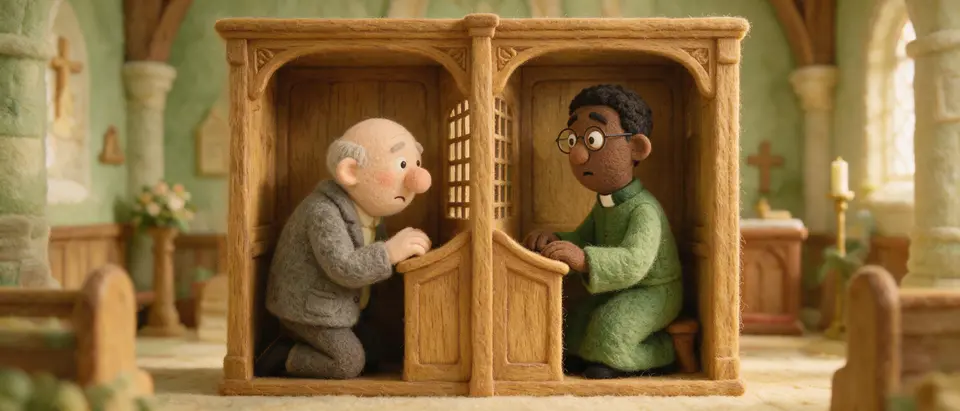
Confessing to the Priest
Disclaimer: this one is dark humour, set in the Holocaust.
A man went to the Priest for confession.
"Forgive me Father, for I have sinned. During the Second World War, I hid a Jewish man in my attic."
"Well," replied the priest, "that is not a sin."
"But I made him pay for every week he stayed."
The priest replied, "That was not right, but you did it for a good cause."
The man exclaimed, "Oh, thank you; that eases my mind. I have one more question."
"What is it son?" The priest asked.
The man whispered “Tenho de lhe dizer que a guerra acabou?Do I have to tell him that the war is over?”
See what it says in English
Click the sentence again to see the Portuguese
The Plus version of this story
With this joke, we do not intend to lessen the horrors of war and human intolerance.
Um homem foi ter com o padre para se confessar."Perdoa-me Senhor, porque eu pequei. Durante a Segunda Guerra Mundial, escondi um homem judeu no meu sótão. ""Bem", respondeu o padre, "Isso não é um pecado.""Mas eu fi-lo pagar por cada semana que ficou."O padre respondeu: "Isso não foi correto, mas fê-lo por uma boa causa."O homem exclamou: "Oh, obrigado; isso alivia-me a consciência. Tenho mais uma pergunta.""O que é, filho?" perguntou o padre.O homem sussurrou “Tenho de lhe dizer que a guerra acabou?”A man went to the Priest for confession.
"Forgive me Father, for I have sinned. During the Second World War, I hid a Jewish man in my attic.""Well," replied the priest, "that is not a sin."
"But I made him pay for every week he stayed."The priest replied, "That was not right, but you did it for a good cause."
There is a Plus version of this story
The same story, taken further, for DailyNata Plus members. This one works on direct object pronouns.
- Whole story in both languages
- Key words explained
- 2 interactive exercises
- Level B1–B2