
Alice in Wonderland
The following is a dialogue from the book “Alice in Wonderland”:
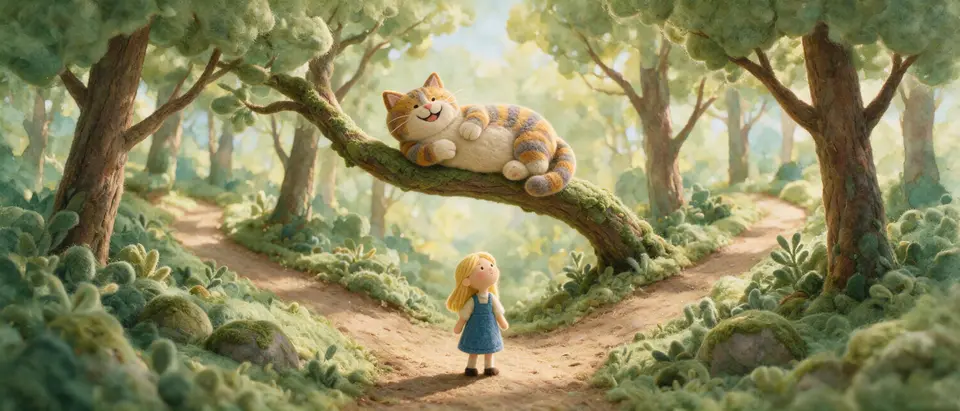
One day, Alice came to a fork in the road and saw a Cheshire cat in a tree.
"Which road do I take?" she asked.
"Where do you want to go?" was his response.
"I don’t know," Alice answered.
"Então," disse o gato, "tanto faz.Then," said the cat, "it doesn't matter."
See what it says in English
Click the sentence again to see the Portuguese
The Plus version of this story
Um dia, a Alice chegou a uma na estrada e viu um gato de Cheshire numa árvore. " estrada ?" perguntou ela. "Onde queres ir?" foi a resposta dele. "Não sei," respondeu a Alice."Então," disse o gato, "tanto faz."
One day, Alice came to a fork in the road and saw a Cheshire cat in a tree. "Which road do I take?" she asked. "Where do you want to go?" was his response. "I don’t know,” Alice answered. “Then,” said the cat, “it doesn't matter.”
Words in this story
Bifurcação (fork)
We call “bifurcação” the place where the road splits in two.
The word “fork” is also an object used for eating that in Portuguese is called “garfo” and the gardening tool called “forquilha.”
Sigo (I take)
This is the verb “seguir” in the present, for the first person singular (eu). “Seguir” means “to follow,” “to continue” or “to carry on.”
There is a Plus version of this story
The same story, taken further, for DailyNata Plus members. This one works on idioms and expressions.
- Whole story in both languages
- Key words explained
- Level B1–B2