
Word Stress in European Portuguese
The rhythm of Languages: Syllable-timed vs. Stress-timed
European Portuguese is a stress-timed language, meaning the rhythm is marked by the stressed syllables (which are said at approximately regular intervals), and unstressed syllables shorten to fit this rhythm.
Other examples of stress-timed languages are English, Russian and German. The rhythm of these languages is based around vowel stress.
For example, in both English and Portuguese, the word “America” is divided into four syllables: A-mé-ri-ca in Portuguese and A-mer-i-ca in English. The second syllable is stressed and thus is given a longer duration in pronunciation. In the other three syllables, there is a significant shortening of the syllables.
Although there is some debate, Brazilian Portuguese is largely regarded as a syllable-timed language, meaning each syllable takes roughly the same amount of time. Spanish and Italian are other examples of syllable-timed languages.
Listen to the following sentence said by native speakers in both Spanish and European Portuguese:
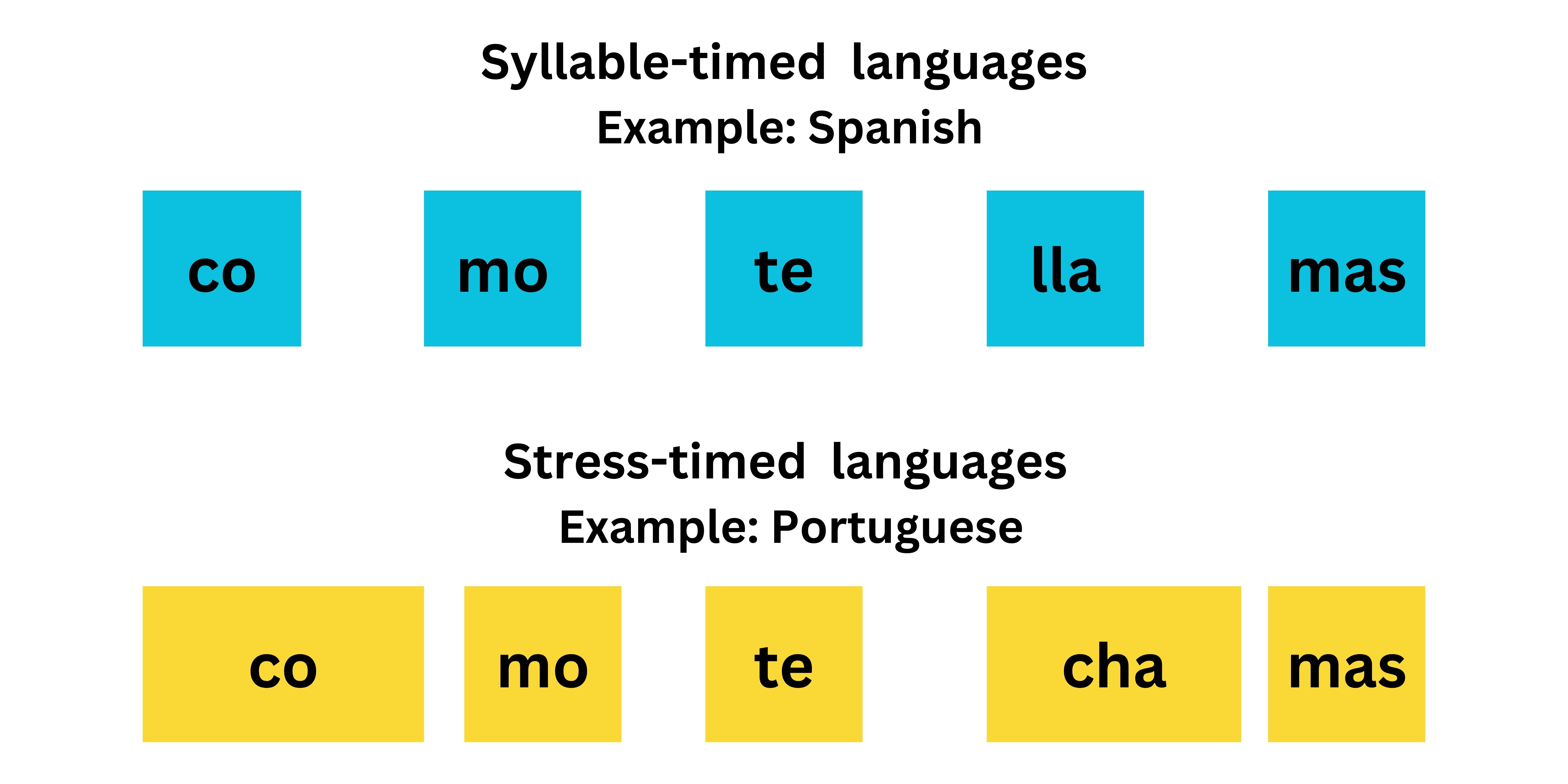
Note that, one language with a specific rhythmic tendency (be it syllable-timing or stress-timing) may manifest the other.
How to know where the stress of a word is?
Stressing the wrong syllable in a word can make the word difficult to understand. It’s important to differentiate, for example, between ‘pais’ (parents) and ‘país’ (country). Fortunately, in Portuguese, there are accent marks and other rules that help us know where the stressed syllable is and that’s what you'll learn now.
There are 3 things to look for:
- Accents: acute ´ and circumflex ^;
- Ending of the word: tilde, -l, -r, -z, -i(s), -im(ins), -u(s), -um(uns) and diphthongs;
- Absence of the previous: stress falls on the syllable that is second to last.
1. Accents (acute ´ and circumflex ^)
If the word has one of these accents, they mark the stressed syllable, taking precedence over the other rules.
- The acute accent ´ (to the right) represents the stress of the words and an open ‘a,’ ‘o’ and ‘e.’ The vowels ‘i’ and ‘u’ are not open or closed and are only marked by this accent to tell where the stress is.
- Fácil (easy), sofá (sofa) bebé (baby), óculos (glasses), açúcar (sugar), veículo (vehicle).
- The circumflex accent ^ over the vowels ‘a,’ ‘e’ and ‘o’ indicates a semi-closed vowel sound and marks the stressed vowel:
- Mecânico (mechanic), âmbar (amber), pêssego (peach), você (formal you) avô (grandfather).
- Exceptions: têm (they have) and vêm (they come) and their compounds: contêm (they retain), sustêm (they sustain), etc, have a nasal sound. Here, the accent is used to distinguish them from ‘tem’ (he/she has) and ‘vem’ (he/she comes).
IMPORTANT NOTE:
- The tilde ~. The tilde is a graphic sign. It is used to indicate nasality and only accompanies the vowels ‘a’ and ‘o.’
- The tilde can mark the stressed syllable when the word has no accent and it is at the end of the word: irmã (sister), maçã (apple), alemães (Germans), leão (lion).
- Examples of when there is another accented syllable: órfão (orphan), órgão (organ), sótão (attic), mãezinha (diminutive of mother).
2. Ending of the Word
The stressed syllable is the last when there is no acute or circumflex accent and:
- The last syllable has a tilde:
- Irmã (sister), irmão (brother), maçã (apple)
- the word ends in L, R and Z
- Jornal (newspaper), papel (paper), anzol (hook), viril (manly), azul (blue)
- Falar (to speak), comer (to eat), dormir (to sleep), valor (value), Artur
- Rapaz (boy), talvez (maybe), feliz (happy), arroz (rice), avestruz (ostrich)
- the word ends i(s); im(ins); u(s), um(uns)
- Abri (I opened), jardim/jardins (garden/gardens), peru /perus (turkey turkeys), atum/atuns (tuna/tunas)
- the last syllable has a diphthong (two vowels together in one syllable)
- Carapaus (horse mackerel), João, gostei (I liked), comeu (he ate).
3. Default stress if the previous situations don’t apply:
If the word is not accented with an acute or circumflex accent and does not end in one of the ways previously mentioned, then the stressed syllable is the penultimate syllable (second to last). This applies to most Portuguese words:
- Sistema (system), amigo (friend), casa (house), falam (they speak), comeram (they ate), palavra (word), simples (simple), etc.
Mark the stressed syllable
The rest of this lesson is for Plus members
Pais or país, sabia or sábia. European Portuguese is stress-timed, so this covers where the stress falls and what the accents are telling you.
- 2 interactive exercises
- Level A2–B1